

Design School Offers: A technology recycling center built on the site of an Apple store in downtown San Francisco was included in Dezeen’s latest school showcase by students at California College of the Arts.
There is also a project proposing digitally manufactured submarine habitats for shellfish and fish, and a pavilion that could be used as a yoga room or meditation tent.
institution: California College of the Arts
school: Department of Architecture
Courses: Bachelor of Architecture, BFA Interior Design, Master of Architecture, Master of Advanced Architectural Design
the teachers: Neeraj Bhatia, Natalie Gattegno, Nigar Kalatnar, Janet Kim, Adam Marcus, Brian Price, Margo Schindler, Alex Schofield, Neal Schwartz, Christine Smith and Clark Thienhouse
School statement:
“The Department of Architecture at California College of the Arts in San Francisco is an arena for the free and open exchange of ideas about the future—of our buildings, our cities, and our planet—and a laboratory where these ideas are tested through speculative architectural and design research.
“Across four academic programs and four research and teaching laboratories, our architecture and interior design students design with aesthetic, social, and environmental issues in mind, producing work that connects image to identity, form to performance, and order to equality.
“The five-year Bachelor of Architecture (BArch) program is NAAB accredited and dedicated to STEM.
“With an emphasis on critical thinking and creativity, students learn how to be agents of change, leveraging their skills toward environmental, social and political impact.
“The Bachelor of Fine Arts in Interior Design is a four-year accredited program with an emphasis on sustainable material practices and spatial innovation in which students learn to design for various human environments, including the home, the workplace, and the public realm.
“This NAAB-accredited, STEM-oriented Master of Architecture (MArch) program supports innovation and experimentation in architectural design, preparing students to lead conversations and develop solutions on some of the world’s most pressing issues.
“In the STEM-oriented Master of Advanced Architectural Design (MAAD), students focus on an independent research or design project through directed study and a range of elective offerings in one of three areas linked to our renowned research laboratories: digital crafts, history theory experiments or urban works.
“At CCA, we are guided by the shared belief that architecture and design are important cultural practices that can and should serve the common good.”
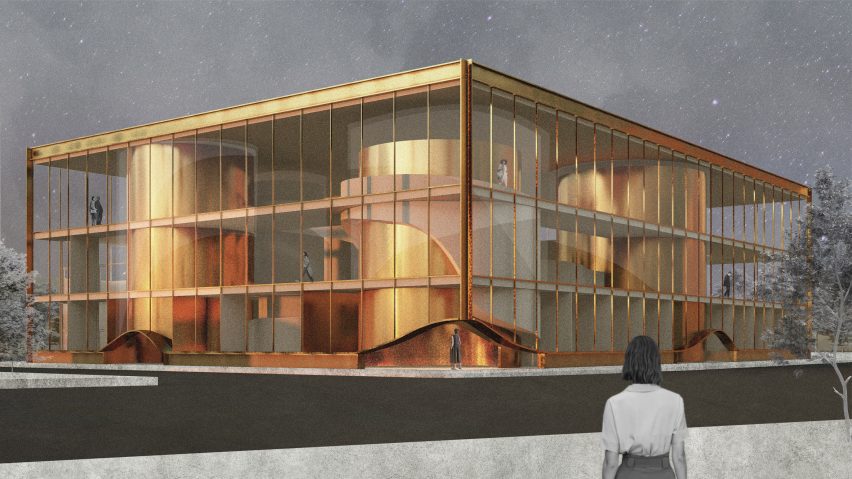
Bodies, Sovereignty, and Hysteria by Lizzie Wilson
“As a response to the overturn of Roe v. Wade and subsequent abortion bans in multiple states, this thesis takes advantage of the political sovereignty granted to consulates as a legal loophole to establish an abortion clinic in Houston, Texas.
“Exploring the hybrid design of the Norwegian Consulate and abortion clinic, the consulate encompasses the clinic and acts as a buffer or safe haven for the clinic within.
“The exterior of the consulate employs modernist ideas of hyper-transparency, as exemplified by Philip Johnson’s Greenhouse, and a solid lattice structure, as found in Mies van der Rohe’s Seagram Building.
“However, the interior design of the clinic contradicts and disrupts the patriarchal design norms of modernity with a different spatial sense that does not rely on any datum or grid.
“Instead, they are loose, free-form and curvilinear, and use curtains as space dividers.”
student: Lizzie Wilson
turn: Master’s thesis in architecture
the teachers: Natalie Gatigneau and Brian Price
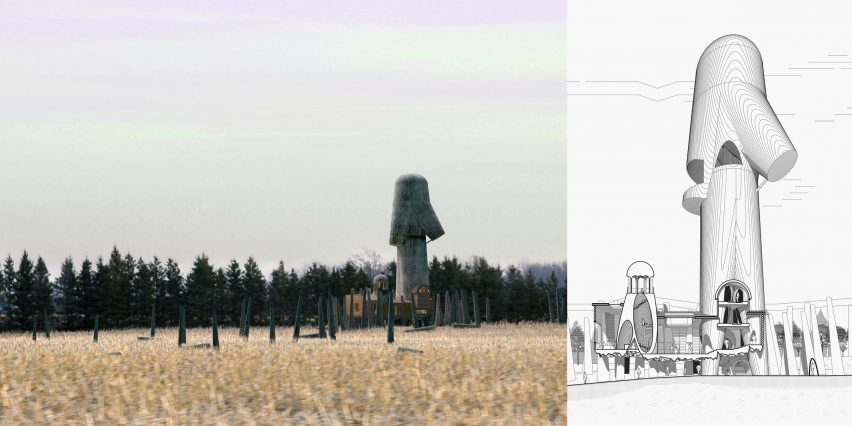
David Rico Gomez Visitor Center
“The Visitor Center explores the concepts of countryside and wilderness in the building design of America’s national and territorial parks.
“The National Park Service has adopted a rusticated form of architectural decoration – dubbed ‘parkitechture’ – as a guideline for use across its buildings.
“When examined closely, many of the architectural elements in NPS buildings are lifted from Midwestern rural architecture: farmhouses, four-squares, and ranch homes.
“The rural Midwest cannot be confused with the wilderness, its fields being strongly controlled and domesticated.
“A forest of bio-engineered columns elevates the building, while grasses and mosses grow between the tree trunks – inside and out – creating a habitat for a diverse ecosystem of microorganisms.”
student: David Rico Gomez
turn: Advanced Architecture Studio: SNAFU
private teacher: Clark Thenhouse
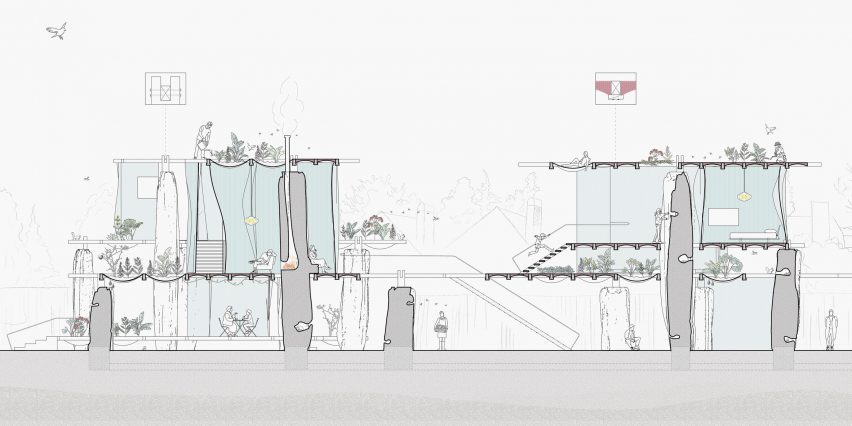
“Loose House” by Claire Leffler and Martin Hitch
“Loose House is an experiment in unpredictability and control.
“At the heart of the project is an experimental technology that combines fabric liners and digitally fabricated molds to form multi-purpose earth columns, which establish the framework for a multi-use habitat that welcomes both human and non-human inhabitants.
“Instead of traditional walls, the project uses several types of curtains to flexibly divide the spaces. In this way, the distinction between inside and outside becomes blurred, allowing human residents to inhabit the structure in a way reminiscent of bird nests.”
students: Claire Leffler and Martin Hitch
turn: Advanced Digital Architecture Studio: Materialities of Care
private teacher: Adam Marcus
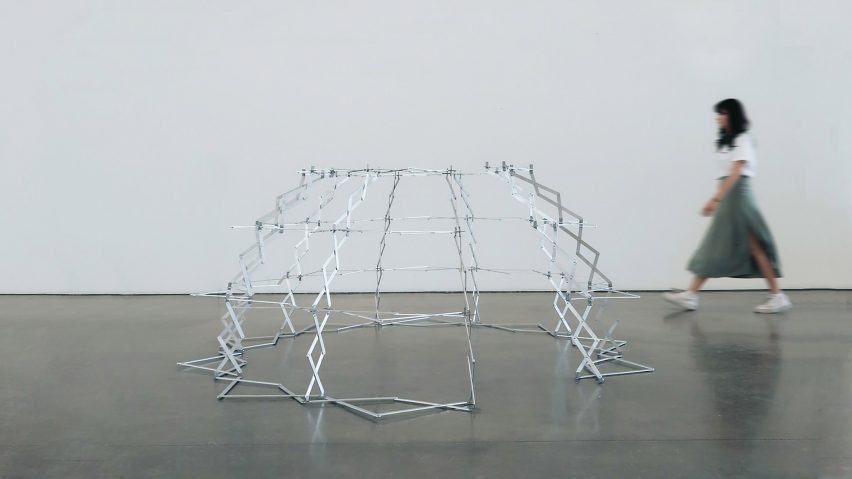
Cupola – Viral architectural design with environmental considerations by Suji Choi, Owen Bhatia, and Elektra White
“The dome addresses the need to quickly create reusable structures.
“The project was conceived in CCA Professor Nigar Kalantar’s studio – an ongoing architectural exploration of adaptable structures guided by pedagogies of movement and computational craft.
“Cupola is a quickly deployable pavilion – useful as a yoga room or meditation tent – and its unique foldable design is achieved through interlocking multi-scissor joints that allow for seamless folding and unfolding.”
students: Suji Choi, Owen Bhatia, and Elektra White
turn: The importance of interior design and space 4: transtudio
private teacher: Nigar Kalantar
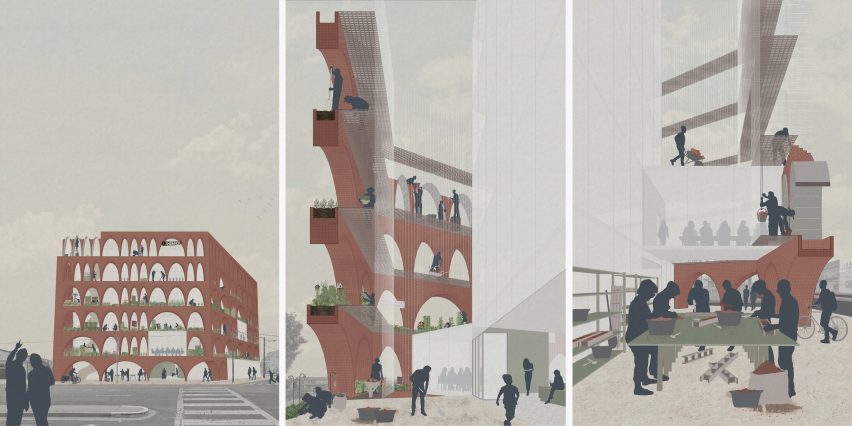
Common Ground by Hannah Leathers
“Common Ground is a response to the unjust way in which land in West Oakland has been marked out, commodified, and contaminated by historic redlining systems, ongoing gentrification, and industrial lead contamination.
“Land is a material and political resource that West Aucklanders are continually denied access to, whether it is land to freely gather, own outright, or farm.
“This proposal acknowledges this narrative and asks how the West Oakland Library can serve as a framework for restoring common ground.
“In this regard, the library acts as a scaffold for the land to grow around, transforming the traditionally programmed library space into a shared land that the community can call its own.
“This process happens slowly over time as the community comes together to build an earthen wall around the library.”
student: Hannah Leather
turn: Mars Studio 3: Remaking the Public Library
the teachers: Neeraj Bhatia and Natalie Gatgno
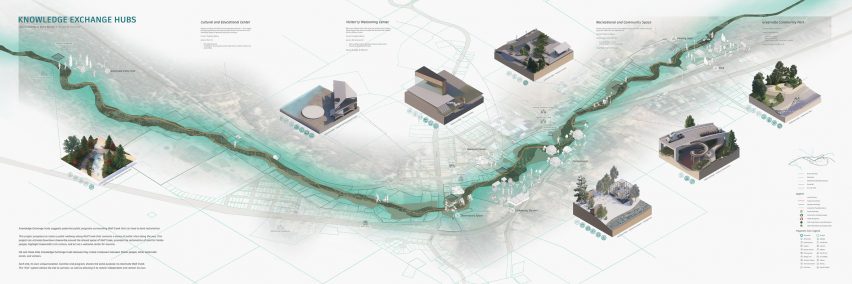
Knowledge Exchange Centers by Luis Arturo Gomez Escobedo and Vicki Sendak
“The Knowledge Exchange Centers are designed for the city of Greenville, which was devastated by the Dixie Fire in 2021, and propose a network of programs and public facilities along Wolf Creek.
“This community services infrastructure – linked by a public trail – will revitalize downtown Greenville and highlight its rich culture, promote land reclamation for the indigenous Maidu people, and serve as a welcome center for visitors.”
“These linked exchange and interaction sites will revitalize Wolf Creek and provide multiple platforms – each with their own program – for people to connect and build community.”
students: Luis Arturo Gomez Escobedo and Vicki Sendak
turn: Architecture Studio for Advanced Urban Works: Property in Crisis
private teacher: Janet Kim
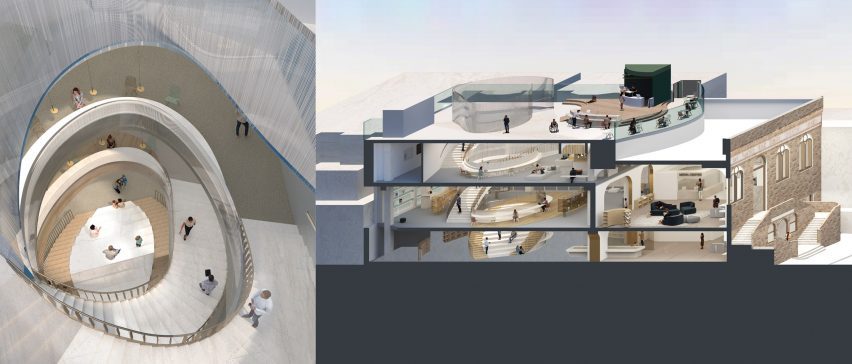
Library 1135 by Jun Hee Koh, Suyang Yao, and Tatiana Watkins
“Located within one of San Francisco’s most widely used branch libraries, 1135 Library preserves the existing facade and reading room of the Chinatown Branch Public Library while reimagining the space for the 21st century.
“To avoid outdated ideas of the library as a ‘quiet space’, this proposal organizes multi-functional spaces based on intended use and noise levels.
“Flexibility is provided by grouping core support functions and maintaining open floor plates while strategically building into niches of intimate space.
“The connection between each of these programs is created through an active open staircase that extends from a new accessible entrance at sidewalk level to an outdoor rooftop terrace with views of the city and bay.”
students: Jun Hee Koh, Suyang Yao, and Tatiana Watkins
turn: Advanced multi-disciplinary interior design studio
private teacher: Christine Smith
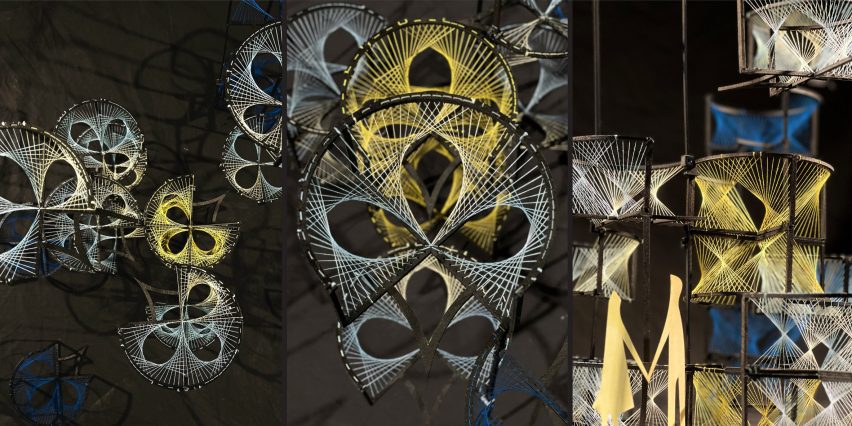
Textured Projections – Adaptive Parametric Environment by Xinye Ju
“Inspired by the work and teachings of Anni and Josef Albers, students in the Matter and Space 3 course in the Interior Design program transformed flexible 2D surface models into a series of woven 3D spatial projections through a combination of formal and material experiments.
“Students were guided by considering the performance of the resulting environment in relation to air, light, sound and colour.
“Soft and hard modular frame assemblies are reconfigured and deconstructed to create interactive, flexible and adaptable indoor environments.”
student: Shiny Jo
turn: The importance of interior design and space 3
private teacher: Margo Schindler
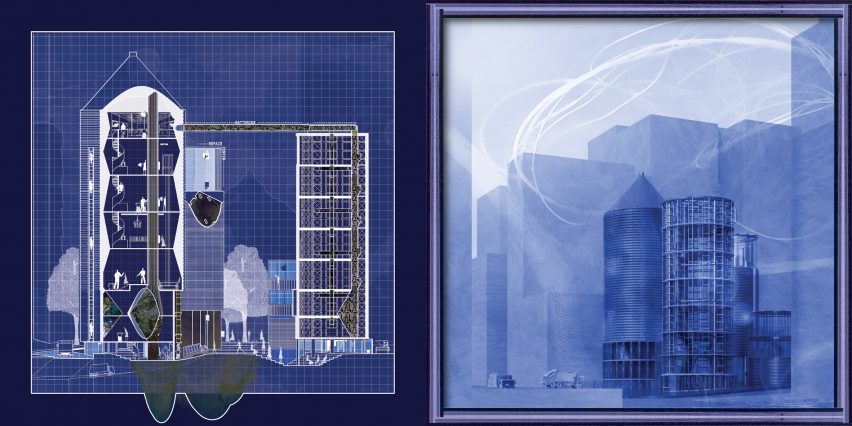
Reimagining the Electronic Wasteland by Ayşe Elif Aydinli
“This thesis project proposes to create a new urban recycling and e-waste recycling center on the site of the existing Apple Store in Union Square in downtown San Francisco.
“The Apple Store is one of the most powerful symbols of capitalist materialism, the culture of planned obsolescence, the culture of neglect, and the aesthetics of consumer desire.
“The thesis envisions the appropriation of this iconic urban space and its transformation into a new typology of civic infrastructure, one that critically reveals the economic, cultural and environmental mechanisms that make it work.
“This new civic recycling center aims to counter the prevailing mentality of ‘out of sight, out of mind’.
“It works from the premise that the buildings that support our consumerism should also reveal their processes and infrastructure, and become important components of our urban environments.”
student: Ayşe Elif Aydinli
turn: Master’s thesis in architecture
private teacher: Neil Schwartz
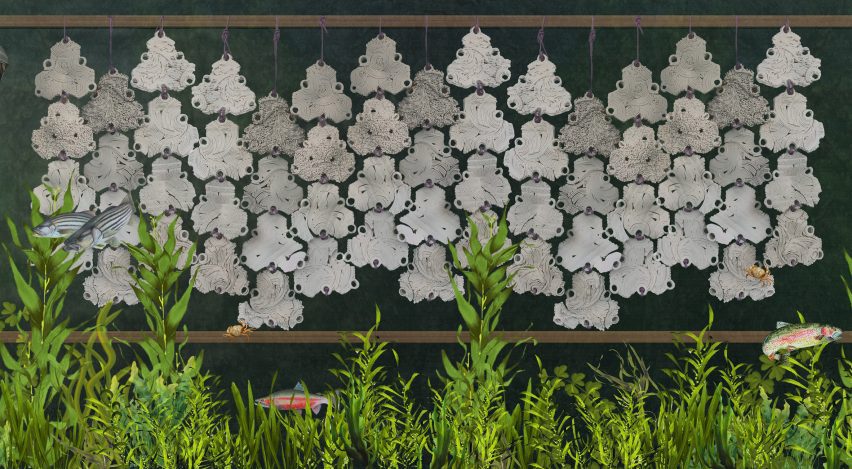
Oyster Shingle by Ahmed Al-Ajmi, Claire Leffler, and Colin Murdock
“The project explores ceramic material assemblages as a center for expanding the environmental performance of architecture.
“It proposes a system of digitally fabricated modular ceramic systems that could serve as an ecological habitat for oysters.
“Drawing on research into the life cycle, geography, ecosystem and habitat of Olympia Oysters, the project explores how artificial substrates can benefit a more biodiverse ecosystem.”
students: Ahmed Al-Ajmi, Claire Leffler, and Colin Murdock
turn: Elective architecture: environmental tectonics
the teachers: Alex Schofield and Adam Marcus
Partnership content
This school show is a partnership between Dezeen and California College of the Arts. Find out more about Dezeen’s partnership content here.
California College of the Arts (CCA) is renowned for its commitment to fostering creativity and innovation in the field of architecture. With a curriculum designed to challenge and inspire students, CCA offers 10 unique projects for architecture students to explore and develop their skills. These projects cover a wide range of topics and challenges, providing students with the opportunity to engage with real-world issues and push the boundaries of conventional design. From sustainable urban planning to experimental structures, CCA’s architecture program offers an immersive and dynamic learning environment for aspiring architects.