


1995 was an exciting year in the gaming industry. The then market leader Sega had to defend its dominance in the West against newcomer Sony: a battle between the Sega Saturn and the Sony PlayStation. The year saw the launch of Windows 95, an operating system that was a clear departure from DOS and provided many exciting games as a platform for the future. And then E3 was also held.
It was the first E3 at the time. The video game trade show was held at the Los Angeles Convention Center and was considered one of the most important in the world. We said “was” because the event officially closed its doors on the morning of December 12, 2023 (US Pacific Time). E3 showed generations of gamers where the gaming world was headed, especially at the beginning.
A time long forgotten
You really have to go back in time to understand what it was like in the early years. The person writing this article only knows E3 from habitually buying gaming magazines. Internet? This was difficult to imagine at the time; There were only a few CompuServe and AOL friends that you would occasionally connect with just to try out the Internet. the television? There wasn’t much showing except for some TV shows about video games. Games still had a somewhat bad reputation in society at the time.
In those days, most gamers got news about the industry mostly through print media, whether gaming magazines or official publications of console manufacturers, such as Club Nintendo. This was something Nintendo did very well at the time.
1995 was also the year that the French media retail chain Fnac pulled out of Berlin. The chain was very unique at the time: not only did it sell laser discs, it also carried imported games that you could only get from specialty retailers. Of course, these were very expensive because international trade didn’t really exist at that point. It was a different era where you still had to buy games through catalogs, from department stores, specialty retailers (which is very rare these days), or dedicated video game chains located all over town.
Sony and Sega compete at E3
E3 was huge when things started to get really interesting in the gaming industry. Just like the Sega Saturn, the PlayStation was showcased at the event shortly before its launch. The Saturn was Sega’s penultimate attempt to survive as a console manufacturer with the help of powerful hardware. Sony used E3 to advertise PlayStation as well as its aggressive pricing. Sure, the Sony console would be available just months later, but at $299, it was $100 cheaper than the Saturn.
At this time, the Nintendo 64 was still a long way from release, and console players around the world were still playing on the Super Nintendo and Mega Drive (also known as the Genesis in North America), which had been relatively successful in selling add-ons such as the 32X. And the Mega CD.
What about the computer? A Windows 95 release was only scheduled for later. But according to a Washington Post article, Microsoft already showed off games for the new platform at E3. This arguably helped the operating system establish itself once and for all the The gaming platform in home computing – which is still the case today.
In the following years, E3 continued to be an important platform for advertising consoles outside of Japan. International publications were still not entirely common at the time, and articles about the Tokyo Game Show did not always provide gamers with sufficient information at the time, especially since TGS only started in 1996. The European Computer Trade Fair in London was another well-known event for gamers. .
Microsoft’s two-pronged entry into the world of consoles
In subsequent years, E3 also became important for another newcomer to the console industry: Microsoft. Key launch details about the company’s consoles were regularly revealed at E3. Sony has continued to offer its PlayStation hardware. Before that, Sega brought another product to the market with the Dreamcast, a console that coincidentally ran Windows CE.
Nintendo is another topic that has been brought up time and time again. The console manufacturer first made the move to discs with the GameCube, before returning to using cartridges in its home consoles with the Switch.
E3 also established itself in the PC gaming industry with big announcements regarding larger titles, many of which somehow ended up on consoles as well, much like how more and more classic console games are getting a PC port.
Although E3 didn’t become completely irrelevant as a platform for consoles and PC in the years leading up to the pandemic, it did lose a bit of its relevance. Triple-A games have been announced often enough for PC, PlayStation, and Xbox. Nintendo just managed to keep doing its own thing.
E3 was unable to demo the current generation of consoles. The PlayStation 5 and Xbox Series E3 switched to an online-only show in 2021 and also will not return to the Los Angeles Convention Center as a proper physical event in 2022 and 2023. And now it’s official history.
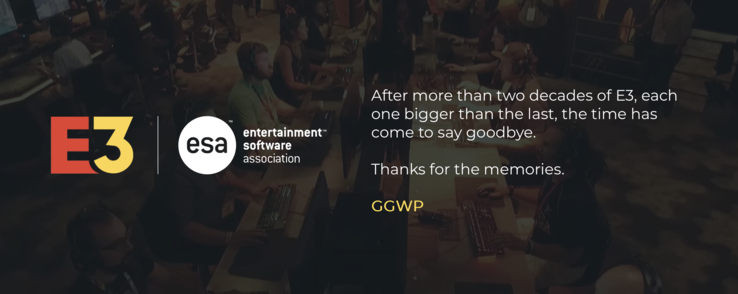
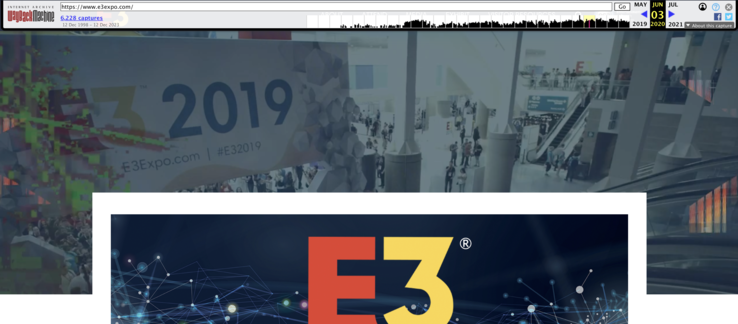
Meanwhile, even the E3 site has all but disappeared. There’s nothing more than a farewell message from the Entertainment Software Association: GGWP – good game, well played. However, this does not mean that the contents have completely disappeared. Thanks to the Internet Archive Project’s Wayback Machine, the E3 site has been saved more than 6,000 times since 1998. There’s not much left to see on the site recently. On the morning of December 12, 2023 (PT), the homepage said that E3 2023 had been cancelled. There was no mention at all of E3 2024.
A show that focuses on the trailer rather than the show floor
E3 has been replaced by several trailer-focused shows. Not only is this cost-effective for companies, but they also don’t have to subject themselves as much to the critical public during game development. The format is fairly convenient if you want to build hype for the game without having to show off the features.
Among the established gaming conventions remain Gamescom in Germany and Tokyo Game Show in Japan. There are also more niche events (such as the Game Developers Conference) and company-focused conventions (such as BlizzCon).
Game Rant has a list of game conventions sorted by scale. There may be some surprises on the list, especially since Game Rant looks at games more broadly.
If you want to take a trip down memory lane, we also recommend reading the above article in the Washington Post. Even though it was published in 2021, E3 has already lost much of its relevance during the pandemic. As a result, the WaPo article actually covers the relevant period of the convention’s history and gives people actively involved in the first few E3 shows a chance to talk about it.

I’ve been involved in IT for over 20 years, first as a system administrator (Mac & PC; 2000-2014) and then as a journalist (2005 onwards). I have attended numerous industry events, such as IDF, Displayweek, Computex, CES, and IFA, to cover topics such as mobile and LANs, Bluetooth standards, and developments in the mobile industry. Since 2017, I have also worked as an aviation journalist, which involves traveling around the world reporting on planes and trains.

After obtaining my bachelor’s degree in Environmental Engineering, I moved from Singapore to Cologne in 2014 and started working as a freelance translator. Most of my translation work focuses on science, engineering, and technology. My passion for computers and portable electronic devices started when I was young. I have fond memories of reading countless tech and gaming magazines. Working with Notebookcheck gives me the opportunity to integrate my personal interests into my professional work.
The E3 gaming conference has long been a highly anticipated event for gamers around the world, showcasing the latest innovations and releases from the biggest players in the industry. However, looking back at the history of the conference, it is fascinating to note the pivotal moment when the Sony PlayStation and Sega Saturn were both set to make their debut in the Western market. The excitement and anticipation surrounding these two consoles marked a significant turning point in the gaming industry, ultimately shaping the future of gaming as we know it today.