

- A leading expert in speech and language acquisition at Charles Sturt University called for communication for all at the recent 74th session of the WHO Regional Committee for the Western Pacific
- Professor Sharyn McLeod spoke as a representative of the University and the International Association for Communication Sciences and Disorders (IALP)
- CCommunication disability has high prevalence rates And andOr mostly invisible
Disability rarely Known biological cause
A leading expert in speech and language acquisition at Charles Sturt University made two interventions at the WHO International Forum in Manila, Philippines.
Charles Sturt Professor of Speech and Language Acquisition Sharyn McLeod (pictured) in the Charles Sturt School of Education attended the recent 74th session of the WHO Regional Committee for the Western Pacific as a representative of the university, the International Association for Communication Sciences and Disorders (IALP) and Charles Sturt University.
Professor McLeod submitted two interventions for the Assembly’s consideration – Agenda Item 13 “Communications for Health” and Agenda Item 14 “Health Workforce”.
She said that the global IALP organization brings together specialists and scholars in the fields of communication, voice, speech-language pathology, audiology and swallowing from more than 50 professional societies. Its mission is to improve the quality of life of individuals with communication, speech, language, voice, hearing and swallowing disorders.
Speaking on the Communication for Health programme, Professor McLeod said: “Communication disability is widespread, and for most people, communication disability is an invisible disability. Most people with communication disability have no known biological cause.
I noticed:
- People with a communication disability include at least 8 percent of children who start school with developmental language disorder (DLD) or speech sound disorder (SSD); 5% of individuals will stutter at some time in their lives, many of whom suffer from voice disorders.
- Some people with a communication disability also have hearing loss, a developmental disability, cerebral palsy, cleft palate, or autism.
- 33% of people with stroke and more than 50% of people with neurological difficulties (eg motor neurone disease, Parkinson’s disease) will have long-term difficulties communicating.
Professor McLeod said: “Communication professionals, including speech-language pathologists, have important evidence-based strategies to support ‘communication for health’ for people with a communication disability.”
Addressing the two agenda issues, Professor McLeod highlighted that to commemorate its centenary, the IALP had published a book, The Underserved: Meeting the needs of people with communication disorders (Levy and Enderby, 2023). This 142-page book will be available for free on the new IALP website, once it is completed.
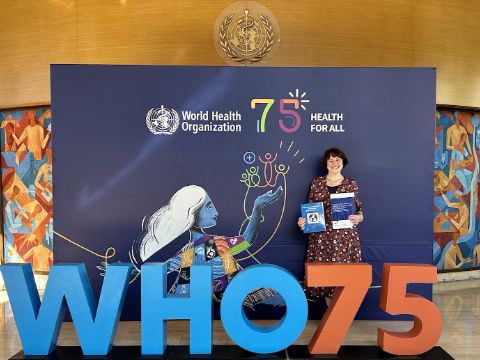 Addressing the two agenda issues, Professor McLeod highlighted that to commemorate its centenary, the IALP had published a book, The Underserved: Meeting the needs of people with communication disorders (Levy and Enderby, 2023). This 142-page book will be available for free on the new IALP website, once it is completed.
 Speaking on the issue of the health workforce (agenda item 14), Professor Macleod said Unserved Provides strategies to address communication and swallowing disabilities that affect many areas of daily life, and are exacerbated by the lack of adequate health, education, and social services.
Professor McLeod noted that one chapter describes the recent establishment of the speech and language therapy profession in Vietnam, including the systematic improvement of the skills of the Vietnamese workforce and the development of new master’s and bachelor’s programs in speech and language therapy across the country.
“The model could be used in other countries, such as Fiji and other Pacific countries, that do not currently have a speech-language pathology workforce,” she said.
Professor McLeod also pointed this out in a special issue of the journal International Journal of Speech Pathology (IJSP2018, Volume 20, Issue 1) Dedicated to addressing the UN agenda of ‘Communication is a human right’, at least four articles have been authored or co-authored by speech pathology academics Charles Sturt.
Likewise, in IJSP The issue focused on ‘Communication, ingestion and the Sustainable Development Goals’ (2023, Volume 25, Issue 1) and at least four other articles were authored or co-authored by academics and students in speech pathology Charles Sturt.
The 74th session of the WHO Regional Committee for the Western Pacific Session was held in Manila, Philippines, from Monday 16 to Friday 20 October.
Learn more on Professor MacLeod’s blog ‘Speaking Languages’.
Speech and language experts from around the world have gathered at the World Health Organization international conference in the Philippines to advocate for greater awareness and support for individuals with speech and language disorders. These experts are emphasizing the importance of early intervention and access to quality services for people with communication challenges. Their goal is to bring attention to the impact of speech and language disorders on overall health and well-being, and to encourage policy makers to prioritize inclusive and accessible healthcare for all. Through their expertise and advocacy, these professionals are working to improve the lives of individuals with speech and language difficulties.